Hot Rolling Versus Cold Rolling: Understanding the Differences in Metal Processing
Ryan Hernden
The forming method you choose, whether hot rolling or cold rolling, influences costs and part properties. Learn more about the differences.


The forming method you choose, whether hot rolling or cold rolling, influences costs and part properties. Learn more about the differences.
Every metal has a recrystallization temperature. When you bend or compress the metal above this temperature, new grains will consume the old, but if you work it below this temperature, the existing grains deform. For any given alloy, this is the difference between hot and cold rolling, and there are big differences in how the metal looks and behaves.
The difference between these two processes has a significant influence on product cost and the material’s final properties, including strength, weight, finish, accuracy, and durability.
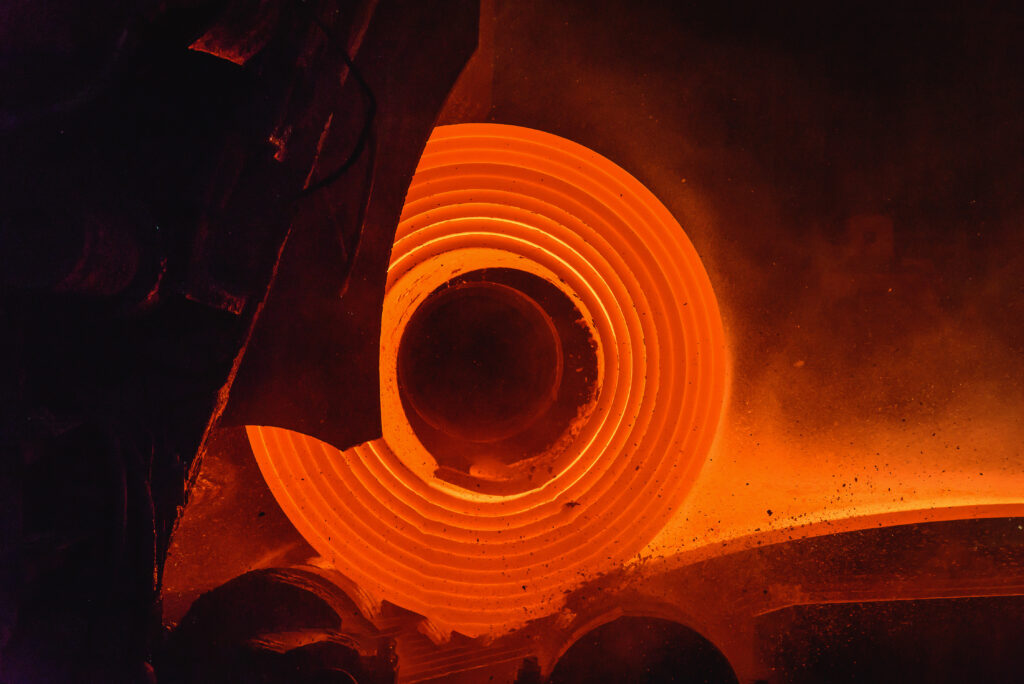
In the hot rolling process, metal is heated above its recrystallization temperature and then rolled thinner or into a specific geometry. This recrystallization temperature is the temperature at which, as the metal is deformed, new grains emerge and consume the old ones. Exact recrystallization temperatures depend on the precise alloy formulation. In general, consider them as:
Material that has been through hot forming has a rough, scaly finish that usually requires a secondary cleaning operation. Grinding, pickling, and bead blasting are all used, depending on final application requirements.
Material that has been deformed through hot working tends to have wide tolerances applied to dimensions and angles due to the unpredictable nature of the process.
Once heated above the recrystallization temperature, metals, even of higher thicknesses, can be readily deformed without high loads or creating any internal or surface stresses. Hot-rolled materials tend to be ductile, so they are readily bent and machined, although they lack high strength and hardness.
These characteristics make hot rolling a relatively inexpensive process for producing a wide range of metal parts that have no internal or surface stresses.
Hot rolling is used for parts that can be machined and bent, and for applications where the external dimensions don’t need to meet tight tolerances. It’s also used when the external metal appearance is of low concern and when cost is a high priority.
Example applications include structural beams and large sheet metal workpieces.
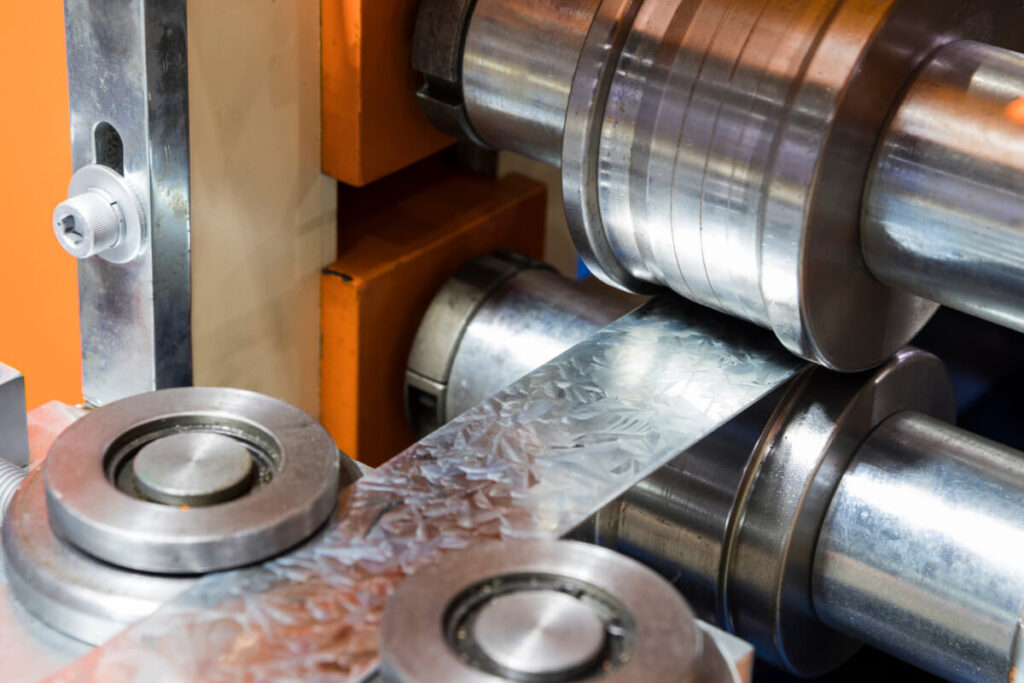
Cold rolling, as the name suggests, is performed below the metal’s recrystallization temperature. This means that, rather than creating new metal grains, those already in the alloy are twisted and deformed, which raises strength and hardness, but reduces ductility.
The reduction in ductility means cold rolling cannot apply as much deformation in a single pass as hot rolling, so it tends to be used in thinner sections, with the metal being put through multiple pairs of rolls to produce the form required.
Cold rolling can create complex cross-sections in strip by sending it through multiple rolls. The individual tools at each roll must be designed to apply a specified amount of deformation, taking into account the changes in material properties that occur.
Cold rolling is accurate and leaves a good surface finish. Complex and even closed forms can be created with careful tool design.
In cold rolling, holes and notches are best put into the strip before the deformations are applied, as the material is softer.
Cold rolling is used to produce parts where surface finish, precision, and appearance are critical, especially for components that have to be assembled and work with other parts, including furniture components (drawer rails, shelving components, and interior frames), appliance components, and automotive parts.
Cold rolling is usually more expensive than hot rolling, but that doesn’t always mean it’s better. The right solution depends on application requirements.
Before you even determine which process to use, it’s best to determine which material to use based on the design objectives. After selecting the material, you should consider which method to use based on part geometry, the mechanical properties needed, and the desired appearance.
Hot rolling often makes sense when:
In contrast, it’s worth paying the premium for cold rolling when:
MMC Roll Form has specialized in custom roll forming since our founding in 1975. Our state-of-the-art facility features 14 roll mills, allowing us to make up to 21 passes to achieve the tightest tolerances. We also maintain an extensive library of roll form tooling that can be reused at no cost to our customers. Our team can even suggest design alterations that allow us to use our existing tooling.
If you need advice, we’re happy to get you started with a detailed project analysis. Our specialists can review your prints and the application requirements, and from there recommend which method is best.