Most of the cost of a product is determined during the design phase. Poor choices of material and manufacturing process at this stage can make a product uncompetitive and doom it to failure.
One area where this is especially true is in the specification of long lengths of material with uniform profiles. Many designers will instinctively opt for extruded material. Depending on the application, that could be a costly mistake. While extrusion is capable of producing complex sections in ductile alloys, it also has a number of limitations.
The alternative is to use roll-formed material. Though the roll forming process is less well-known than extrusion, it offers design, cost, and performance benefits in many situations.
Roll Forming
Roll forming is a continuous process that takes flat, coiled metal strip and processes it into a uniform profile. This process is done on a roll forming line, which consists of multiple pairs of profiled rollers. Each pair applies a deformation to the strip, with successive pairs increasing and adding to the deformation previously put in.
With over a dozen roll stands, a roll forming line can give flat strip a ‘C’, ‘U’, or more complex profile with flat or radiused surfaces. It’s even possible to create closed forms by overlapping one side of the coil with the other.
Many roll forming lines incorporate a pre-punch station immediately before the first roll stand, which puts holes and slots into the strip before it’s formed. At the end of the line, a cut-off station cuts strip to the required length.
Advantages
- Cost-Effective: A roll forming line runs at high speed, and pre-punching eliminates secondary operations. Together, these make the process an inexpensive way of producing large quantities.
- High Material Utilization: There’s very little waste with roll forming.
- Material Choices: Roll forming can handle most types of steel, including stainless, as well as non-ferrous materials like aluminum and copper. It can also form coated materials, avoiding costly finishing operations.
- Design Flexibility: Roll forming can create complex sections with high stiffness, making it suitable for a range of structural applications.
Limitations
Roll forming lines require multiple sets of custom rollers to apply the deformations needed. These are expensive to machine and take time to set up. This can make roll forming expensive for low-volume orders.
Additionally, unlike extrusion, roll forming works on a single thickness or gauge of material, making it difficult to produce parts of the profile with differing thicknesses.
Best Use Cases
- Racking and shelving
- Wall framing
- Channel for electrical and network cables
- Automotive components (window channels, door frames, and structural reinforcements)
- Solar panel frames and mounts
- Furniture (support beams and rails, decorative trim, handles, and hinges)
Extrusion
Extrusion involves forcing metal through a shaped die to produce long lengths with a uniform profile. Extrusion can be performed cold, although heating is often used to soften the metal and raise its ductility.
Extrusion processes are split into direct or forward extrusion and indirect or backward extrusion. In forward extrusion, a ram forces the material through a fixed die. In backward extrusion, the die is part of the ram and is pushed into the material billet, forcing the material to extrude out through the center of the ram/die. Backward extrusion requires less force than forward extrusion, as there’s no friction between billet and housing walls, and it’s often used to form more complex profiles.
Extruded material is cut to length after forming and usually requires a straightening operation.
Advantages
- Complex Profiles: Extrusion dies can form thin sections, closed regions within the profile, and areas of differing thickness.
- Tensile Strength: Extruded material tends to have greater tensile strength than profiles made by roll forming, principally because more material is used per unit length.
- Process Scalability: Extrusion is suitable for medium- to high-volume production.
Limitations
Extrusion only works with metals that have enough plasticity to flow through the die, so it is primarily used with ductile, non-ferrous alloys like aluminum. Hot extrusion can process more challenging materials, but the resulting surface is often poor and in need of secondary finishing.
The need for dies machined from tool steel also imposes significant lead time and costs for the production of new profiles. It also means there is some set-up time. Combined with the size of billet required, this means producers may have a minimum production quantity.
Best Use Cases
- Window and door frames
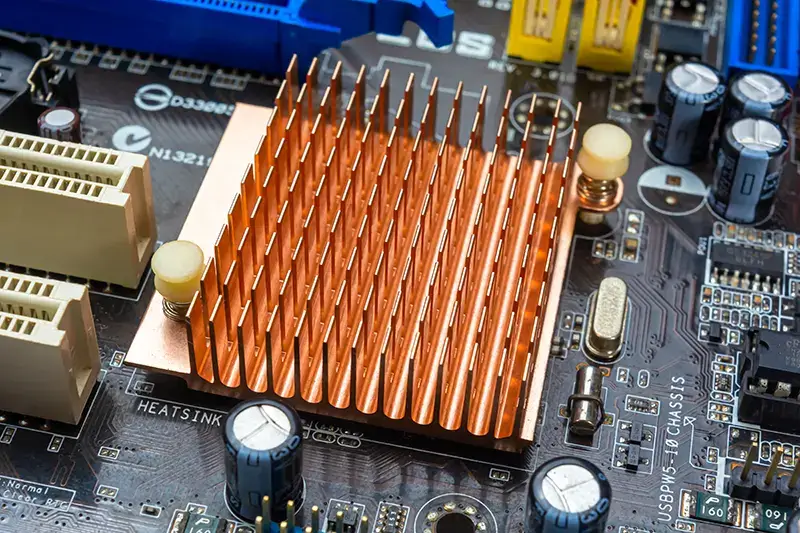
- Electronics (especially for heat sinks)
- Machine frames
- Barriers and safety guards
- Brackets and hinges
See if Roll Forming Is Right for You
MMC Roll Form specializes in producing and distributing high-quality metal roll-formed products for numerous industries and applications. Our state-of-the-art facility features roll mills, which allows us to achieve the tightest tolerances possible. We also help our customers save money by offering an in-house library of pre-made tooling that can be re-used at no additional cost, as well as in-line piercing and punching. For many products, custom roll forming provides the most cost-effective method of manufacture, but it isn’t the right choice for every application. If you’re working on a design that uses lengths of uniform profile, or you’re looking for cost-reduction opportunities, ask our experts if roll forming would work for you.